

Verpan Iconic Verner Panton Lighting, Danish Furniture & Scandinavian Design
Verpan brings the extraordinary world of Danish designer Verner Panton to contemporary interiors through a collection of iconic lighting, furniture, and accessories defined by color, experimentation, sculptural form, and an unmistakable sense of optimism. Working closely with Verner Panton Design AG, Verpan preserves and reintroduces some of Panton’s most celebrated designs while bringing rediscovered pieces from his remarkable archive to new generations.
From the luminous VP Globe and cascading FUN chandeliers to the sculptural Pantop, Moon, Spiral, and Wire lighting collections, Verpan demonstrates Panton’s revolutionary understanding of how light can shape atmosphere. Furniture including the Cloverleaf Sofa, System 1-2-3 seating, Series 430, Easy Series, Barboy, and other designs expands that vision into complete interiors created for living, gathering, conversation, and play.
Verpan Preserves and Reintroduces the Radical Design Legacy of Verner Panton
Verpan takes its name directly from Verner Panton, one of the most original and influential figures in 20th-century Danish design.
Rather than functioning simply as a manufacturer of historic reproductions, Verpan works to preserve, reissue, and recontextualize Panton’s extensive body of work for contemporary life.
This distinction is important.
Panton’s designs were never intended to be static museum objects. His furniture, lighting, textiles, and interiors were conceived as active participants in the way people live, socialize, work, and experience space.
Verpan continues that philosophy by returning original designs to production and placing them within contemporary residential, hospitality, workplace, and contract environments.
The result is a collection with genuine historical significance that still feels remarkably alive.
Verner Panton Changed Danish Design Through Color, Experimentation, and an Optimistic Vision of the Future
Born in Denmark in 1926, Verner Panton emerged during a period when Danish design was internationally celebrated for natural materials, refined craftsmanship, and restrained modernism.
Panton respected that tradition but refused to be limited by it.
He embraced color.
He experimented with plastics, fiberglass, metal, synthetic materials, reflective surfaces, new manufacturing technologies, and unconventional forms.
Furniture became more fluid.
Lighting became more theatrical. Interiors became immersive environments in which walls, floors, ceilings, furniture, textiles, and illumination could participate in a single experience.
This willingness to move beyond established Scandinavian conventions gave Panton a singular position in design history.
His work could be playful without becoming frivolous, futuristic without losing humanity, and visually radical while remaining fundamentally concerned with how people experience space.
Verpan Lighting Demonstrates Verner Panton’s Revolutionary Understanding of Light, Color, and Atmosphere
Lighting was central to Verner Panton’s creative world.
He understood that a lamp could do far more than illuminate a room.
Light could alter color, change the perception of surfaces, create intimacy, introduce movement, and transform the emotional character of an interior.
The Verpan lighting collection reveals the extraordinary range of this experimentation.
VP Globe explores transparency, reflection, and suspended geometry.
FUN creates movement and sound through cascading discs. Moon uses concentric metal lamellae to sculpt light, while Spiral transforms reflective elements into a dynamic hanging composition.
Pantop reduces the lamp to a beautifully recognizable bell-shaped form.
Wire celebrates an open structural framework.
Together, these designs show that there was never one single “Panton look.” What connects them is curiosity about what light can do.
VP Globe Is One of Verner Panton’s Most Iconic Danish Modern Pendant Lights
Designed in 1969, VP Globe has become one of Verner Panton’s most recognizable lighting designs.
Its transparent outer sphere reveals an intricate internal composition of reflectors and suspended elements, turning the mechanics of the light into part of its visual identity.
The transparent globe creates a fascinating contradiction.
The fixture has substantial physical presence, yet it remains visually open.
Architecture, furniture, and surrounding space remain visible through it.
The internal reflectors appear to float inside the sphere, giving the lamp an almost planetary quality.
This Space Age character places VP Globe firmly within the experimental culture of the late 1960s while allowing it to remain compelling in contemporary interiors.
Above a dining table, within a living room, or suspended in an architectural space, VP Globe functions as both illumination and sculpture.
VP Globe Demonstrates Panton’s Fascination with Transparency, Reflection, and the Space Age
The late 1960s were defined by extraordinary optimism about technology, space exploration, new materials, and the future.
Panton absorbed this cultural energy.
VP Globe captures it particularly well.
The transparent sphere suggests a satellite, planet, or technological capsule, while the internal composition creates layers of reflection and illumination.
Rather than hiding the components of the lamp behind a conventional shade, Panton made them visible.
This approach allows the viewer to understand the light as an object in space.
Modern versions and material interpretations expand the collection while preserving the essential idea: a transparent volume containing a precisely composed luminous world.
For designers, this makes VP Globe especially effective where visual openness is important.
It can command attention without creating the heavy opaque volume of a traditional chandelier.
The FUN Lighting Collection Turns Movement, Reflection, and Sound into a Sensory Experience
Introduced in 1964, the FUN series demonstrates Panton’s ability to transform repeated elements into something theatrical.
Hundreds of suspended discs create a layered, shimmering surface around the light source.
The elements respond to movement in the surrounding environment.
They catch illumination from changing angles and can gently interact with one another, adding another sensory dimension to the fixture.
This makes FUN more than a static decorative lamp.
It has rhythm.
It changes as someone walks past it.
It appears dense from one perspective and more transparent from another.
The collection encompasses pendants, table lamps, floor lamps, and wall lights, allowing the concept to operate across very different scales.
FUN Chandeliers Bring Verner Panton’s Expressive Danish Lighting to Dramatic Architectural Spaces
The larger FUN pendants demonstrate how Panton’s lighting can become architecture.
At substantial scale, the repeated hanging elements create luminous volumes capable of defining dining rooms, staircases, hotel lobbies, restaurants, reception areas, and other significant spaces.
Despite their visual richness, these fixtures maintain a surprising sense of lightness.
The individual discs overlap rather than forming one solid opaque surface.
Light penetrates the composition and reflects across countless elements.
This combination of scale and transparency makes FUN particularly valuable in interiors that require drama without visual heaviness.
The chandelier becomes an event within the room—precisely the kind of emotional, social, and sensory experience that fascinated Panton throughout his career.
Moon Lighting Uses Concentric Metal Rings to Shape Light into a Sculptural Composition
Designed in 1960, the Moon lamp is an early demonstration of Panton’s interest in controlling illumination through structure.
The fixture is formed from concentric vertical lamellae arranged around the light source.
These elements can create a changing relationship between concealment and exposure, shadow and illumination.
From different viewpoints, the lamp appears to shift.
The geometry feels precise, yet the visual experience remains dynamic.
Moon’s spherical character also anticipates the Space Age sensibility that would become increasingly visible throughout Panton’s work during the following decade.
Its combination of simple components and sophisticated visual effect demonstrates one of the designer’s greatest strengths: creating extraordinary experiences from clear structural ideas.
Pantop Lighting Distills Verner Panton’s Playful Design Language into an Elegant Bell-Shaped Form
Designed in 1980, Pantop represents a more distilled side of Verner Panton’s design language.
Its defining feature is a widely flaring bell-shaped shade directed downward.
The form is immediate, friendly, and easy to understand.
Yet the simplicity is precisely what gives Pantop its versatility.
Unlike some of Panton’s more theatrical designs, Pantop can enter an interior quietly or become expressive through color.
Pendant, table, and portable versions allow the same recognizable silhouette to move throughout a project.
A Pantop pendant can provide focused illumination above a small table.
The table lamp works on desks, consoles, and bedside tables, while the rechargeable portable version allows the design to move wherever light is needed.
Pantop Portable Brings Verner Panton’s 1980 Design into Flexible Contemporary Living
Portable lighting gives a historic design an unexpectedly contemporary function.
The Pantop Portable retains the distinctive flared silhouette of Panton’s 1980 lamp while freeing it from a fixed electrical location.
It can move from a dining table to a bookshelf, bedside table, terrace, or hospitality setting.
A broad palette of colors reinforces another central Panton principle: color is not an afterthought.
It changes the emotional identity of the object.
A restrained neutral Pantop can integrate quietly into an interior, while vivid orange, red, blue, teal, or reflective finishes create a much stronger visual statement.
The result demonstrates how an authentic design from 1980 can adapt naturally to the way people live today.
Spiral Lighting Transforms Repeated Reflective Elements into a Dynamic Verner Panton Chandelier
Spiral is another powerful example of Panton’s fascination with movement and reflection.
Suspended spiral elements capture surrounding light and redirect it through the room.
As viewers move around the fixture, the surfaces continually change.
The lamp therefore resists being understood from a single viewpoint.
Its appearance depends upon movement, illumination, and surrounding architecture.
Gold and silver finishes intensify the reflective effect, giving Spiral a glamorous quality without relying upon conventional crystal-chandelier language.
Available in several configurations and scales, the series can create anything from a concentrated decorative moment to a dramatic installation.
Wire Lighting Celebrates Open Structure and the Graphic Beauty of a Metal Framework
The Wire series, designed in 1972, demonstrates how Panton could create visual impact while using remarkably little material.
Its open metal framework establishes the volume of the lamp without enclosing it.
This reduces visual weight and allows light to interact freely with the surrounding space.
The geometry itself becomes decorative.
Lines define the form, while the relationship between the frame, shade, and illumination creates depth.
Wire table and floor lamps work particularly well in contemporary interiors because their open construction does not overwhelm nearby furniture.
The design feels distinctly connected to the experimentation of the 1970s yet remains graphically relevant today.
Panto Pendant Explores Transparency and Suspended Geometry in a Classic 1977 Verner Panton Light
Designed in 1977, the Panto pendant continues Panton’s exploration of transparent spherical lighting.
A clear acrylic outer sphere contains suspended white reflectors held by steel chains.
The structure is simultaneously visible and mysterious.
From a distance, the internal elements seem to float inside the transparent shell.
A subtle touch of red, visible from below, introduces the kind of unexpected color detail that appears throughout Panton’s work.
Like VP Globe, Panto allows the surrounding room to remain visible through the fixture.
Its transparent architecture makes it particularly effective where designers want a substantial pendant without creating a visually solid mass.
Verpan Furniture Brings Verner Panton’s Radical Vision of Social Living into Contemporary Interiors
Panton did not design furniture simply as isolated objects.
He thought about how people interacted within rooms.
Seating could encourage conversation.
Curves could change the way people gathered. Modular elements could create new spatial relationships, and color could alter the emotional experience of an environment.
Verpan’s furniture collection preserves this social dimension.
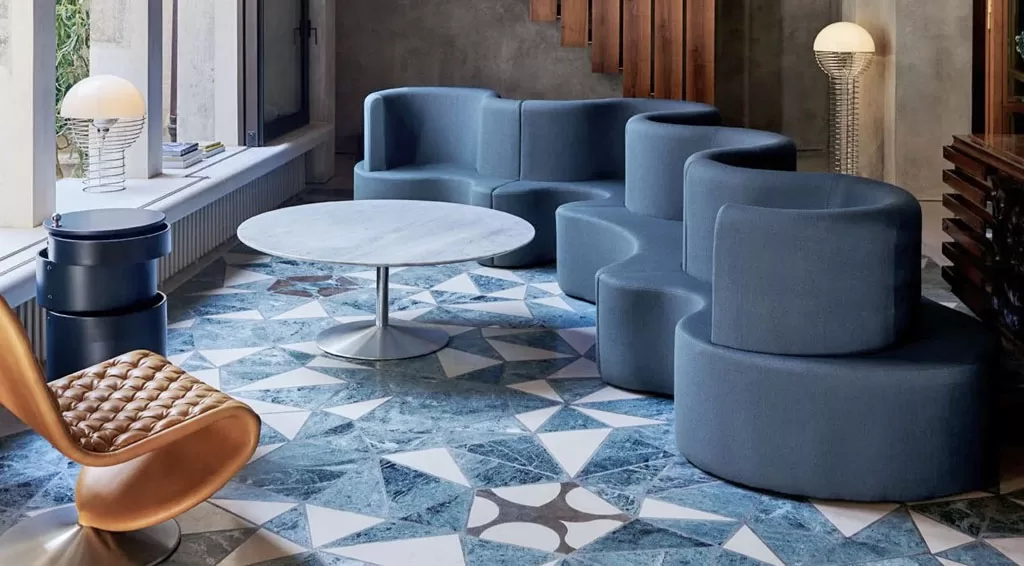
Cloverleaf creates flowing seating landscapes rather than conventional straight sofas.
System 1-2-3 explores ergonomic sitting through a distinctive continuous profile.
The Easy Series embraces informal relaxation, while Series 430 brings comfort and sculptural form to dining.
Barboy turns mobile storage into a colorful object.
Together, these pieces allow contemporary interiors to recover some of the freedom and optimism that made Panton’s original environments so extraordinary.
The Cloverleaf Sofa Is an Icon of Verner Panton’s Sculptural and Social Approach to Seating
Designed in 1969, Cloverleaf is one of Panton’s most extraordinary seating concepts.
Instead of placing people along a conventional straight sofa, its undulating form creates a continuous landscape of curves.
People can sit facing different directions.
The furniture begins to influence how conversation happens and how the surrounding space is organized.
This is an important distinction.
Cloverleaf is not simply a sofa with an unusual silhouette.
It is a spatial tool.
Multiple elements can create longer compositions, allowing the design to grow according to the architecture.
In large residences, hospitality interiors, lounges, galleries, workplaces, and public environments, Cloverleaf can become a sculptural room divider as well as seating.
Cloverleaf Indoor and Outdoor Seating Extends Panton’s Social Furniture into New Environments
The continuing development of Cloverleaf demonstrates the durability of Panton’s original concept.
Verpan offers upholstered versions for interior applications as well as interpretations designed for indoor-outdoor use.
This allows the sculptural form to move beyond conventional living rooms.
Covered terraces, hospitality environments, cultural spaces, creative workplaces, and other settings can use Cloverleaf to create informal gathering zones.
The design’s success across different environments comes from the strength of the original idea.
Its identity is not dependent upon a particular fabric or decorative treatment.
The architecture of the seating itself creates the experience.
System 1-2-3 Seating Combines Sculptural Form with Verner Panton’s Study of the Human Body
Developed in 1973, the System 1-2-3 series reflects Panton’s continuing investigation into new ways of sitting.
Its extended seat and back form creates a distinctive continuous profile.
The chair appears sculptural from every angle, yet the form is fundamentally connected to the body.
Dining and lounge versions allow the language to work across different functions.
Upholstered surfaces introduce softness, while the supporting structure gives the furniture visual lightness.
System 1-2-3 is especially compelling in contemporary interiors where a chair needs to look intentional from every direction.
Around a dining or conference table, repeated silhouettes create a strong rhythm.
Used individually, the lounge chair can become a sculptural accent.
Series 430 Dining Chairs Combine Generous Comfort with an Elegant Verner Panton Silhouette
Panton believed dining furniture should encourage people to remain at the table.
The Series 430 chair reflects that social idea through generous upholstery and a supportive form.
Its relatively simple silhouette makes it easy to use in multiples, while the curved seat and back give the chair enough personality to remain distinctly Panton.
Paired with the Series 430 table or other contemporary dining tables, the chair creates a setting that balances visual clarity with comfort.
This combination is important for residential dining rooms, restaurants, conference environments, and hospitality spaces where people may remain seated for extended periods.
The Easy Series Creates a Relaxed Landscape for Informal Modern Living
The Easy Series, introduced in 1964, reflects the cultural shift toward more informal interiors during the 1960s.
Instead of emphasizing upright formality, the furniture encourages relaxed sitting and social interaction.
Easy chairs, sofas, and poufs use generous forms to create comfortable compositions.
Their sculptural character allows them to work individually, but the pieces become especially effective when grouped into larger lounge environments.
The concept feels surprisingly current.
Contemporary homes, hotel lounges, creative offices, and hospitality spaces increasingly prioritize flexible areas where people can sit casually, converse, work, or relax.
Panton was exploring these ideas decades earlier.
Barboy Turns Mobile Storage into a Colorful and Functional Verner Panton Design Object
Designed in 1963, Barboy reflects the optimism and flexibility of the early Space Age.
Its cylindrical form contains rotating storage compartments, allowing the object to remain compact while revealing different functions as needed.
Originally conceived in the context of entertaining, Barboy can serve many purposes in contemporary interiors.
It can function as a bar, bedside table, mobile storage unit, or occasional piece.
Casters add mobility, reinforcing the idea that furniture does not always need to remain fixed in one position.
Available in multiple colors, Barboy also demonstrates Panton’s ability to give a highly functional object an unmistakable personality.
Verner Panton Designed Complete Environments Rather Than Isolated Pieces of Furniture
One of the most important ways to understand Panton is to look beyond individual products.
His ambition extended to entire environments.
Furniture, lighting, textiles, color, walls, ceilings, floors, and architectural elements could all participate in one immersive composition.
This concept helps explain why Verpan lighting and furniture work so naturally together.
A VP Globe is not merely a pendant.
A Cloverleaf is not merely a sofa.
A FUN chandelier is not merely decorative lighting.
Each object can contribute to the atmosphere and social character of the room.
For contemporary architects and interior designers, this offers an opportunity to use Panton’s work at several scales—from a single iconic object to a more complete interior environment.
Color Is Fundamental to the Emotional Power of Verner Panton Furniture and Lighting
Panton treated color as a design material.
It could influence mood, change the perception of scale, connect objects, create contrast, or transform the atmosphere of an entire room.
This distinguishes his work from much of the restrained Scandinavian modernism with which he is often historically grouped.
Verpan continues to make color central to the collection.
Pantop appears in expressive contemporary shades.
Furniture upholstery can create bold monochromatic statements or more restrained compositions.
Barboy becomes dramatically different depending upon its finish, while metallic lighting uses reflection to introduce another kind of color experience.
For designers, Panton’s work provides permission to treat color confidently rather than as a final decorative layer.
Verner Panton’s Space Age Designs Captured the Optimism and Experimentation of the 1960s
The early and late 1960s were transformative periods in Panton’s career.
Moon appeared in 1960.
Barboy followed in 1963, while FUN and the Easy Series arrived in 1964.
By 1969, designs such as Cloverleaf and VP Globe expressed an increasingly immersive and futuristic vision.
These objects developed alongside enormous cultural change.
Space exploration, new plastics and synthetic materials, Pop Art, experimental music, cinema, and counterculture were reshaping expectations of what the future might look like.
Panton did not simply adopt a superficial Space Age style.
He participated in a broader rethinking of how people might live.
His furniture became less formal, lighting became more atmospheric, and interiors became more sensory.
Verpan Demonstrates That Authentic Midcentury and Space Age Design Can Still Feel Radically Contemporary
Historic design can sometimes feel tied to the period in which it was created.
Panton’s best work has largely avoided that fate.
VP Globe still looks futuristic.
Cloverleaf still challenges conventional assumptions about how a sofa should be arranged.
Pantop remains strikingly simple, while FUN continues to produce a sensory experience that feels unlike most contemporary lighting.
This longevity comes from originality.
Panton was not designing incremental variations of existing objects.
He was asking fundamental questions about color, material, light, sitting, movement, and social interaction.
Because those questions remain relevant, the designs remain relevant as well.
Verpan Accessories Extend Verner Panton’s World of Color, Pattern, and Optical Experimentation
The Verpan collection also includes accessories that reveal another side of Panton’s creative universe.
Mirror sculptures transform reflective surfaces into geometric wall compositions.
Rugs and textiles introduce pattern, color, and tactile character, while smaller objects allow Panton’s visual language to enter an interior without requiring a major piece of furniture.
These accessories are especially useful for creating the kind of layered environments Panton envisioned.
A room can combine furniture, lighting, texture, pattern, reflection, and color rather than treating each category independently.
Even a single mirrored object can change how light and surrounding colors are perceived.
Verpan Outdoor Furniture Brings Iconic Verner Panton Design to Terraces and Contemporary Exterior Spaces
The Verpan collection increasingly allows Panton’s design language to move between interior and exterior environments.
Outdoor interpretations of selected furniture make it possible to extend sculptural seating onto terraces, patios, hospitality spaces, and other appropriate exterior settings.
This feels particularly relevant to contemporary architecture, where the boundaries between indoor and outdoor living continue to dissolve.
Panton’s strong forms translate naturally.
The furniture does not rely upon traditional domestic references, making it equally compelling against architecture, landscape, concrete, stone, or contemporary outdoor materials.
Verpan Furniture and Lighting Create Memorable Hospitality, Restaurant, and Workplace Interiors
Panton’s work has always possessed a strong social character, making it particularly appropriate for hospitality and contract environments.
Cloverleaf can create communal seating within hotel lounges and creative workplaces.
Series 430 works naturally in restaurants and meeting rooms, while System 1-2-3 provides distinctive seating for dining and conference environments.
Lighting can establish an equally strong identity.
VP Globe creates a recognizable focal point.
FUN and Spiral can bring drama to larger spaces, while Pantop and Wire provide more intimate illumination.
Verpan’s own project references demonstrate the collection across hospitality, residential, workplace, and cultural environments.
Verpan Balances Design Heritage with Responsible Contemporary Production
Preserving historic design also creates a responsibility to consider how those products are made today.
Verpan emphasizes long product life as a central sustainability principle.
This is particularly appropriate to Panton’s work because authentic design retains cultural and functional value over time.
The company also works to introduce recyclable materials where possible and develops products with assembly, disassembly, repair, and responsible end-of-use in mind.
Supplier relationships, production methods, logistics, shipping, and packaging form additional parts of this effort.
The most sustainable object is often one that people value enough to keep.
Panton’s designs have already demonstrated an unusual ability to survive changes in fashion and culture.
Authentic Verner Panton Design Offers Lasting Cultural Value Beyond Short-Lived Interior Trends
There is an important difference between a retro-inspired object and an authentic design from the period.
Verpan provides access to original Verner Panton designs created from his actual body of work and produced in collaboration with the organization responsible for preserving his legacy.
That provenance matters.
A VP Globe is not merely a lamp that looks like the 1960s.
It is part of the design history that helped define the period.
Cloverleaf did not imitate Space Age seating—it helped establish a new way of thinking about furniture and social space.
This authenticity gives Verpan products significance beyond decoration.
They connect contemporary interiors directly to one of the most experimental chapters in modern design.
Verner Panton’s 100th Anniversary Reinforces the Enduring Influence of His Radical Danish Design
Born in 1926, Verner Panton reaches his centenary in 2026.
A hundred years after his birth, the continuing relevance of his work is remarkable.
Designs created in the 1960s, 1970s, and 1980s continue to appear in contemporary homes, hotels, restaurants, offices, galleries, and cultural spaces.
The centenary provides an opportunity to view Panton’s work not as a collection of isolated icons but as an evolving creative journey.
Moon and Barboy reveal the optimism of the early 1960s.
FUN and Easy reflect changing ideas about lifestyle and sensory experience.
VP Globe and Cloverleaf capture the radical experimentation of the late 1960s.
Wire and System 1-2-3 demonstrate the flexibility of 1970s living, while Pantop shows Panton moving toward a more distilled formal language in 1980.
Together, they reveal a designer whose greatest consistency was his refusal to stop experimenting.
Discover Verpan Verner Panton Lighting, VP Globe, FUN Chandeliers, Pantop Lamps, and Iconic Danish Furniture at Scott + Cooner
Scott + Cooner offers Verpan as part of our curated collection of exceptional Scandinavian and international design.
Since 1995, Scott + Cooner has worked with architects, interior designers, and design-conscious clients seeking extraordinary modern furniture, lighting, kitchens, closets, rugs, accessories, and design objects for sophisticated residential and contract interiors.
Our experienced team can help you explore Verpan lighting including VP Globe, FUN, Moon, Pantop, Spiral, Wire, Panto, and other collections, along with furniture such as Cloverleaf, System 1-2-3, Series 430, Easy, Barboy, and additional Verner Panton designs.
Whether you’re searching for an iconic Danish pendant light, a sculptural Verner Panton chandelier, a colorful portable lamp, an authentic Space Age sofa, distinctive dining chairs, or a complete environment that captures Panton’s extraordinary vision of color, light, form, and social living, Scott + Cooner can help you discover Verpan and select the right pieces for your project.